There are films that entertain, films that inspire, and then there are films that feel like events carved into myth itself. Wrath of the Gods (2026) belongs to the last category. From its very first frame, the screen trembles under the weight of ancient power, setting the stage for a cinematic colossus where the divine collides with the mortal in a storm of fury, fire, and fate.
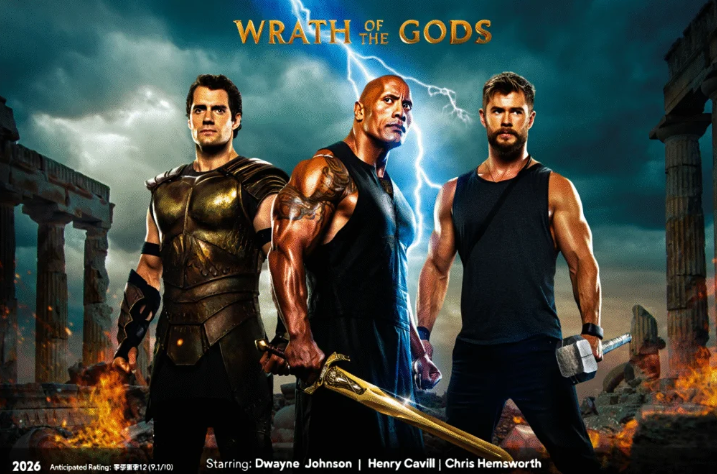
The premise is as grand as it is primal: gods descending to reclaim dominion over humanity, their wrath turning the world into a crucible of destruction. Lightning splits the heavens, oceans churn with rage, and the very ground quakes beneath their march. Director Marcus Legrand embraces spectacle not as excess, but as poetry—each battle a hymn to chaos, every visual a fresco painted in thunder and flame.
At the heart of this godly maelstrom stand three warriors, each a force of nature in his own right. Dwayne Johnson embodies Kaelor, a demigod of sheer strength, his presence a wall of muscle and defiance. He is the anchor of the film, carrying with him both primal rage and an unexpectedly tender humanity. Every strike he delivers feels like it could shatter the bones of the earth itself.
Henry Cavill’s role as Arion, the fallen champion, provides the film with its soul. Once exalted, now disgraced, his journey is one of redemption, his eyes burning with both sorrow and unyielding resolve. Cavill brings gravitas to the role, balancing heroic idealism with the torment of a man who has tasted failure and dares to rise again. His arc becomes the heartbeat of the narrative.
And then there is Chris Hemsworth as Theron, the stormbringer. Few actors embody the dance of arrogance and awe as effortlessly as Hemsworth. His storms are not merely weather—they are symphonies of violence, crashing down in fury as he strides through battle like a god in exile. Yet beneath the thunder lies a flicker of doubt, a mortal vulnerability that humanizes the tempest.
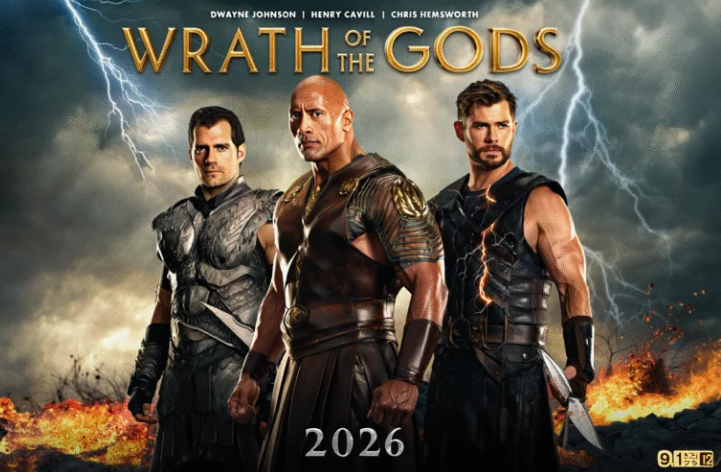
The film thrives not just on its colossal set pieces, but on the dynamic between its leads. Johnson’s grounded might, Cavill’s tortured nobility, and Hemsworth’s volatile charisma weave together into a triad of destiny. When they share the screen, it feels less like acting and more like watching elemental forces collide—fire against stone, lightning against steel.
The battles themselves are nothing short of staggering. Cities crumble into dust, mountains are split in two, and the sky burns with celestial warfare. Yet the spectacle never overshadows the story. Legrand ensures every clash has weight, every strike a consequence, every victory a cost. The gods are not faceless titans—they are beings of pride, vengeance, and insecurity, and their fury feels terrifyingly human.
Cinematography transforms myth into reality, with sweeping shots of burning horizons and intimate close-ups capturing the flicker of fear in a warrior’s eye. The use of scale is masterful: one moment, the camera dwarfs humanity beneath the immensity of the divine; the next, it reminds us that even gods can bleed, their immortality cracking beneath mortal defiance.
The score deserves its own legend. Thunderous drums echo like the heartbeat of creation, choirs rise in defiance of oblivion, and strings wail like mourners of a dying world. It is music that doesn’t just accompany the film—it possesses it, carrying the audience into the very marrow of battle.
By the time Wrath of the Gods reaches its finale, the world itself feels changed. Sacrifices have been made, betrayals revealed, and triumph wrested from the jaws of annihilation. Yet the film leaves us with more than spectacle—it leaves us with reflection. What does it mean to challenge the divine? To defy wrath with hope? To stand small in the face of eternity, yet refuse to bow?
With a blazing anticipated score of 9.1/10, Wrath of the Gods is more than a blockbuster—it is myth reborn for a modern age. This is cinema at its most titanic, where gods rage, mortals rise, and legends are forged in fire and storm. Humanity may be fragile, but here, in the crucible of wrath, it is also unbreakable.